

Corporate Holiday Party Transportation: The Return Trip
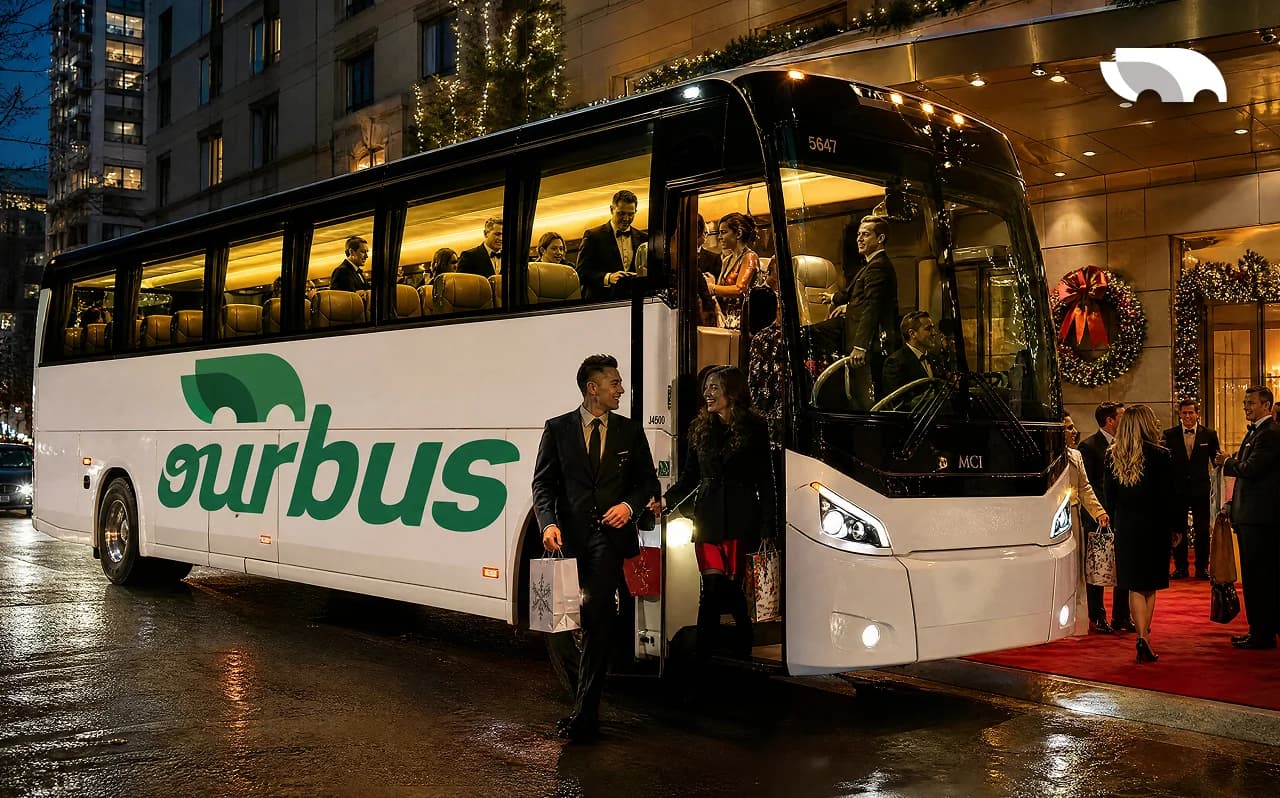
Why is the ride home the hard half?
The last departure is the time the final guest leaves, and it is the number that moves a party quote most. In our experience it is also the one hardly anyone has settled when they call for a price.
That has practical consequences:
· The venue's closing time is not your end time. Forty people collecting coats, finishing conversations and finding each other at the door is a slower load than the same forty leaving an office at 6 p.m. Build a margin in, and tell the operator what it is.
· A dispersed return is a sequence, not a trip. Four drop zones across a metro is four legs, each later than the last, and the driving added at the end of the night is the part of a party return that grows. We found on one December job that the drops took longer than the run out to the venue had.
One return or two?
Decision | Your options | Who settles it |
How many departure times you announce | One late departure, or two staggered ones | You, when the invitations go out |
Where the bus waits in between | Held nearby, or released and recalled | The venue, by whether it has the room |
Keeping them apart matters, because they are independent. Two announced departures with the bus held nearby is an ordinary booking. So is two departures with the bus sent away in between. Let's say you announce 9:30 and 11:30: whether the bus waits near the venue between those runs or leaves and comes back is not really your call — it is whatever the venue can accommodate.
On cost, ask rather than assume. The OurBus Charters charter bus rental prices page puts the usual minimum booking at four to five hours, and notes that local trips are often billed hourly while longer or multi-day routes may be flat or per-day. So whether holding the bus adds anything depends on which structure your quote uses, and on whether the night fits inside that minimum at all.
Consider a party running 7 p.m. to 10 p.m.: pick up at 6:30, last drop finished by 11:15, and the whole evening sits under five hours. Have both shapes priced against your own quote instead of assuming two staggered departures cost double.
What does reliably cost more is the shape nobody plans: no announced time at all, with the bus waiting on the last straggler.
Where does the bus wait during the party?
A hotel with its own coach apron is one problem. A downtown restaurant on a narrow street is another entirely, because a 56-seat coach runs about 45 feet — three cars nose to tail — and most city curbs will not hold one for four hours even where they allow a brief stop. What forces release-and-recall is usually the absence of anywhere legal to sit, not the length of the event. We ran into the parking problem far more often than the long-party problem.
Three things to settle with the venue, and with your operator if it has run there before:
· Whether there is on-site space for a bus your size, and for how long. A loading bay that works for a twenty-minute unload is not a four-hour parking space.
· Where the driver is expected to be if there is not. Some venues will point you at a nearby lot; others have no answer, which is itself the answer.
· Whether the pickup door moves after dark. A daytime coach stop at a convention venue is not always the same door at 11 p.m.
December adds two more. Guests wait outdoors at the end of a winter night, so a covered door beats a loading bay fifty feet further on by a margin that would not matter in June. And a bay that drains badly ices over, which is a reason to ask where the bus will actually sit rather than where the site map says it may.
Settle that and the return shape mostly chooses itself. A venue with room makes a held bus and a second departure straightforward. A venue with none makes release-and-recall the honest option, and that in turn makes the last departure a time you commit to rather than discover.
What should you send for a quote?
· The venue address, and the time the event formally ends.
· The last departure time you will actually hold people to.
· Whether you want a second, earlier run, and roughly how many would take it.
· Where people are going back to: one office, one hotel, or named drop zones.
· Headcount, firm or estimated, and whether it differs outbound and back.
· The pickup point, and whether anyone joins you at the venue.
That last pair matters more than it looks. Groups that travel out together often come back in two directions, and a return that splits needs either a second bus or a second run. Settle it before the invitations go out rather than at the last minute.
For a company party the usual vehicles are a mini bus for a single department or a full charter coach for a whole office, and a shuttle bus rental if the venue is close enough that a short repeated run beats holding a bus at all.
Send the return times and we can price it
You will not find rate figures in this post, or advice on how far ahead to book. Both belong to the prices page and to a planner who knows your city and your date. More about us, and everything else we cover, is on the OurBus Charters homepage.
Corporate holiday party transportation FAQ
How do you plan transport for a party with no fixed end time?
Set a last departure time and announce it with the invitation rather than deciding it at the party. An unannounced end leaves the bus waiting on whoever goes last, and whether that costs you anything depends on your quote's structure and your minimum booking. A second, earlier run gives people an exit without extending the night.
Is it cheaper to send the bus away and bring it back?
There is no universal answer, so ask rather than assume. What usually decides it is space, not cost: if the venue has nowhere a 45-foot coach can legally sit for four hours, the bus has to leave and come back whatever the arithmetic says. Where it can stay, have your operator price holding against releasing on your own quote.
Can one bus do two return runs from a holiday party?
Often yes, and it is worth asking rather than assuming. If the bus is being held near the venue anyway, an earlier departure is mainly a scheduling question. Give the operator both times and the rough split between them, and let the quote show you the difference.
How many drop-off points can one bus make on a holiday party return?
As many as the night has room for, since each one adds driving at the end of an already long evening. In practice two or three named drop zones beat a door-to-door chain of twelve, and they keep the last guest's arrival time predictable. Send the zones with your quote request so the route is priced rather than improvised.
Do you need separate vehicles for the outbound and the return?
Only if the groups differ. Parties where everyone travels out together but leaves in two directions need either a second bus or a second run, and that is a common reason a holiday party quote comes back higher than expected. Settle the return shape first.